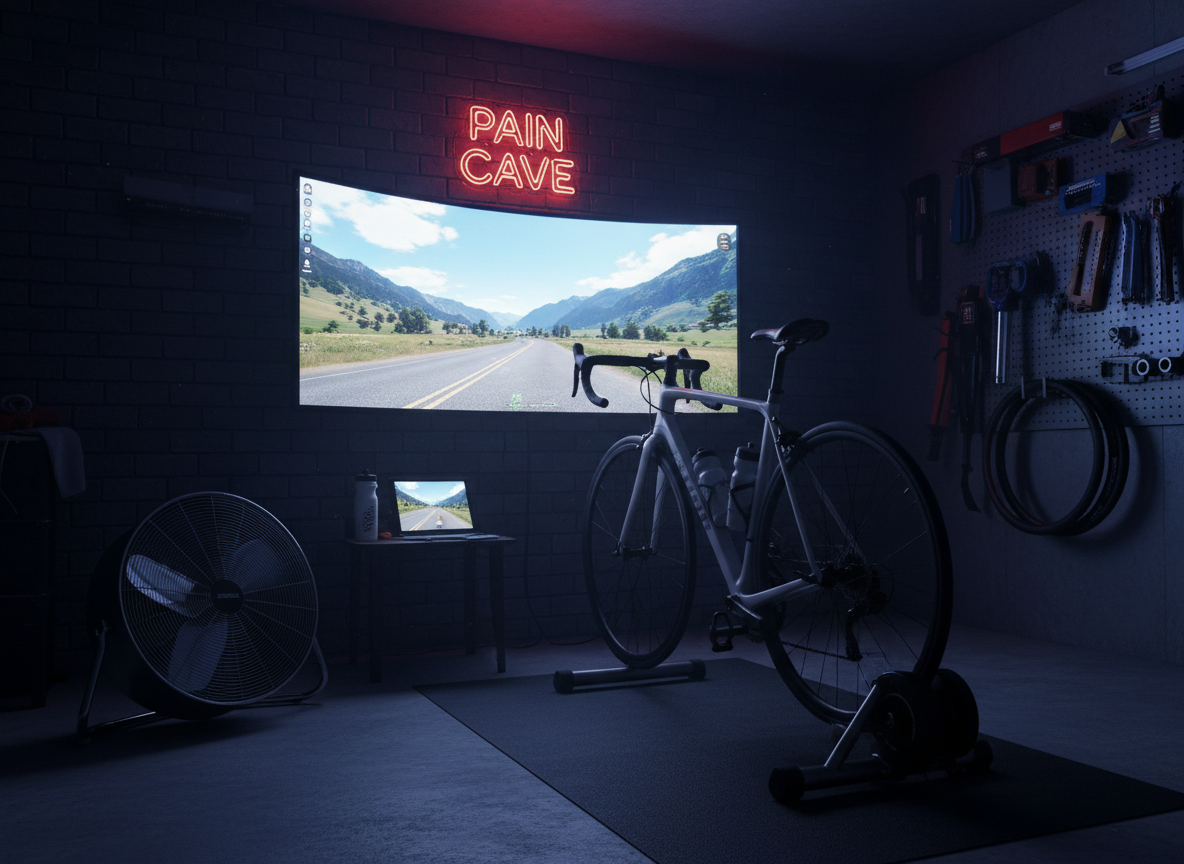
Zwift vs TrainerRoad: Which Indoor Training App Is Better for You?
🚴 Head-to-Head
Zwift vs TrainerRoad
This post contains affiliate links — we may earn a commission at no extra cost to you. See our full disclosure.
If you’re training indoors this winter — or you’re a triathlete who needs consistent bike fitness without outdoor time — you’ve almost certainly landed on these two names. Zwift and TrainerRoad are the two biggest platforms in indoor cycling training, and they take almost opposite approaches to get you fitter.
Neither is “better” in the abstract. One is built to make you want to ride. The other is built to make you faster with the least amount of time wasted. Here’s how to pick.
Indoor training also has a safety angle worth mentioning: no traffic, no drivers checking their phones, no early-morning or late-night visibility risk, and no black ice or wet roads to worry about. For anyone training through a Midwest winter, or just squeezing in a hard interval session during rush hour, that’s not a small benefit — it’s often the difference between getting the workout done at all and skipping it.
The Short Answer
Zwift ($19.99/month or $199.99/year): A virtual world you ride through, with group rides, races, achievement badges, and other riders around you. Training happens, but the experience is built around motivation and entertainment first.
TrainerRoad ($21.99/month or $209.99/year): A no-frills, data-driven training platform built entirely around getting you fitter as efficiently as possible. Minimal interface, AI-built training plans, and adaptive workouts that adjust to your actual fitness — no virtual world, no racing, no chat.
If you dread indoor training and need something to make it fun, pick Zwift. If you’re already motivated and want the most effective use of your training hours, pick TrainerRoad.
Pricing
| Zwift | TrainerRoad | |
|---|---|---|
| Monthly | $19.99 | $21.99 |
| Annual | $199.99 | $209.99 |
Both require a smart trainer (or a power meter + trainer combo) to get full value — structured workouts on either platform are far more useful with automatic resistance control than with a manual “dumb” trainer.
Where They’re Different
Training Philosophy
TrainerRoad’s whole platform is built around its Plan Builder — an AI-driven system that creates a customized training plan based on your goals, your available training time, and your current fitness. Its Adaptive Training feature then adjusts upcoming workouts based on how you’re actually responding, not just a fixed plan written months in advance.
Zwift offers workout libraries and training plans too, plus pace-partner bots that hold a steady effort so you can draft and pace off them in a group setting. But its structured training is a feature bolted onto a platform whose real focus is the virtual world experience.
Social and Gaming Elements
Zwift leans hard into gamification: a persistent virtual world, group rides, organized races, achievement badges, and equipment/avatar customization you unlock as you ride more. For a lot of people, this is what makes indoor training sustainable through a long winter — there’s a reason to log in beyond “I should train today.”
TrainerRoad strips all of that out. No virtual world, no avatars, no races. Just a workout graphic, your power target, and your numbers. Some athletes find this focus valuable; others find it sterile.
Who Actually Gets Faster
This is where it gets nuanced. TrainerRoad’s structured, adaptive approach is built by people obsessed with training science, and serious cyclists and triathletes who follow it consistently tend to see strong, measurable fitness gains. But the platform that makes you actually show up and finish your workouts consistently is the one that works — and for a meaningful number of athletes, that’s Zwift, precisely because it’s more fun to open.
Who Should Choose Zwift?
- Cyclists and triathletes who find indoor training boring or mentally hard to sit through
- Anyone motivated by group rides, virtual races, or friendly competition
- Beginners to structured training who want workouts without a steep learning curve
- Multisport athletes who also want run/treadmill integration (Zwift supports running too)
See Zwift Membership Pricing →
Who Should Choose TrainerRoad?
- Athletes training for a specific race (marathon-supporting bike fitness, triathlon, gran fondo) who want a structured, periodized plan
- Cyclists who already know they’re self-motivated and don’t need gamification to show up
- Data-driven athletes who want an adaptive plan that responds to their actual performance
- Anyone who’s outgrown generic training plans and wants something built around their specific FTP, time availability, and goals
See TrainerRoad Membership Pricing →
Can You Use Both?
Some athletes do — TrainerRoad for the bulk of structured interval work during the week, and Zwift for a Saturday group ride or race as the “fun” session that keeps them from burning out on structure. If budget allows, this hybrid approach gets you the training rigor of one platform and the sustainability of the other.
The Bottom Line
TrainerRoad is the better tool if your only goal is getting fitter in the fewest hours possible and you don’t need external motivation to log in. Zwift is the better tool if the virtual world and social pressure are what get you on the bike in January when it’s 20 degrees outside. Most triathletes and cyclists already know, honestly, which one they are.
Check out our Garmin Running & Triathlon Watches Compared and our Best Running Shoes for Marathon Training guide for more.


2 Comments